The Missing Keywords in President Lai's Second Anniversary Speech
United Daily News Commentary, May 20, 2026
President Donald Trump of the United States recently stated that he “does not want to see anyone move toward Taiwan independence,” and even said he does not want to fight a war over it. This blunt warning undoubtedly has had a powerful “course-correction” effect on the Democratic Progressive Party’s (DPP) long-standing cross-strait narrative.
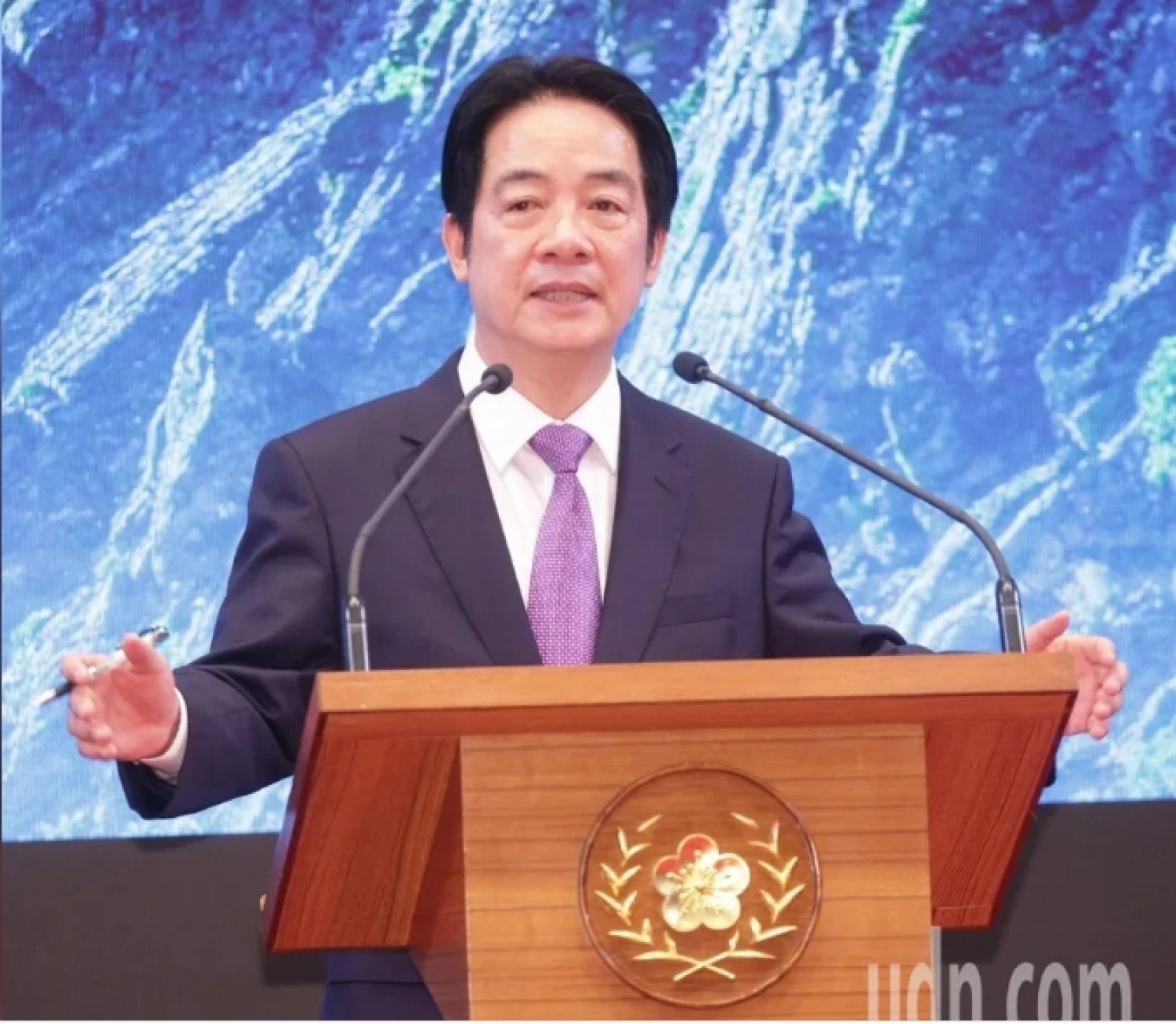
Observing President Lai Ching-te’s speech today marking the second anniversary of his taking office, one no longer sees the passion and sharpness of the “new two-state theory” that characterized his rise to office two years ago. The most implicit yet significant declaration in today’s speech was his positioning of the national strategic objective as “maintaining peace and stability in the Taiwan Strait and preventing external forces from changing the status quo.” Yet behind this seemingly balanced banner of “maintaining the status quo,” two major keywords were deliberately hidden or softened.
In fact, both former President Tsai Ing-wen and President Lai, the leaders of the DPP during its decade in power, have advocated “maintaining the status quo,” though each has done so in a subtly different way. The “Resolution on Taiwan’s Future,” passed in 1999, has always served as the theoretical foundation for the DPP’s status quo position. The most significant passage in the resolution states:
“Taiwan is a sovereign and independent country, whose sovereignty extends only over Taiwan, Penghu, Kinmen, Matsu, and their affiliated islands, as well as territorial seas and adjacent waters in accordance with international law. Taiwan, although currently named the Republic of China under the Constitution, is not subordinate to the People’s Republic of China, and any change to the current status of independence must be decided by all residents of Taiwan through a referendum.”
Although President Lai reiterated in today’s speech the ironclad position that the R.O.C. and P.R.C. are not subordinate to each other,” the paradox is that the four words at the very heart and soul of the Resolution on Taiwan’s Future—“independent status”—completely disappeared from today’s address. Faced with the “no support for Taiwan independence” red line drawn by Mr. Trump, President Lai’s cross-strait discourse has been forced to bow to international reality, retreating strategically to the narrower position of merely “preventing external forces from changing the status quo.”
What has drawn even greater attention is that in this speech marking the second anniversary of his inauguration, the terms “Republic of China” and “Republic of China Taiwan” each appeared symbolically only once. President Lai clearly sought to conceal two key terms: one being “Taiwan independence,” which the DPP has long treated as a sacred principle, and the other being the R.O.C., which carries the constitutional system itself.
Attempts at concealment often make the absence even more conspicuous. As President Lai tried to use the ambiguous notion of the “status quo” to cover up the disappearance of these two key terms, Taiwan’s future itself seemed to become a mirage. Much like the Taiwan depicted on the DPP party flag, the country appears to stand anxiously at a crossroads. Yet today’s speech by President Lai arguably pushed the nation into an even more vague and intangible predicament.
Former DPP caucus whip Ker Chien-ming proposed in 2013 the idea of “freezing the Taiwan independence party platform,” but the initiative was shelved and left unresolved by then-party chair Tsai Ing-wen. To this day, it remains an unresolved “legacy of independence.” Even though President Lai recently stated that “there is no Taiwan independence issue,” as long as the DPP does not substantively address the controversy surrounding its pro-independence platform advocating the establishment of a “Republic of Taiwan,” this unexploded political bomb will continue to serve as an unstable variable in cross-strait relations and geopolitics.
President Lai stated in his speech that Taiwan must “prevent external forces from changing the status quo in the Taiwan Strait,” but he appears to have forgotten that the status quo has never been static. It is a constantly shifting process shaped by ongoing power struggles. With a single remark, Mr. Trump recalibrated the DPP’s Taiwan independence discourse. Ironically, this demonstrates that the “external force” most capable of changing Taiwan’s status quo may not be Beijing alone.